- March 2026
Closing the digital execution gap across the defence ecosystem
Europe’s defence sector is entering a new phase of transformation. Rising geopolitical tensions, evolving security threats, and sustained pressure to deliver capabilities at speed are reshaping how defence organisations design, produce, and sustain military capabilities. While defence spending across Europe has increased significantly in recent years, operational readiness increasingly depends on digital readiness.
Our BearingPoint research1 explores how digital transformation is progressing across Europe’s defence value chain, spanning both the Aerospace & Defence industry and the Public Defence sector. It examines where digital ambition is highest, where maturity still lags, and what it will take to close the growing digital execution gap that limits speed, scale, and resilience across the defence ecosystem.
Why digital execution has become a strategic priority
Defence capability is inherently an ecosystem endeavour. Governments, armed forces, industry players, and technology partners must operate in close coordination to deliver operational outcomes. As programmes grow in scale and complexity, fragmented digital architectures, siloed data, and governance constraints increasingly limit the ability to translate investment into deployable capability.
At the same time, higher budgets alone do not automatically translate into faster delivery. Without scalable digital processes, interoperable architectures, and sufficient execution capacity, defence organisations struggle to absorb higher throughput and operational complexity.
A clear digital execution gap across the defence value chain
BearingPoint’s research, based on a survey of 151 senior defence executives across six European countries, reveals a consistent pattern across both industry and government.
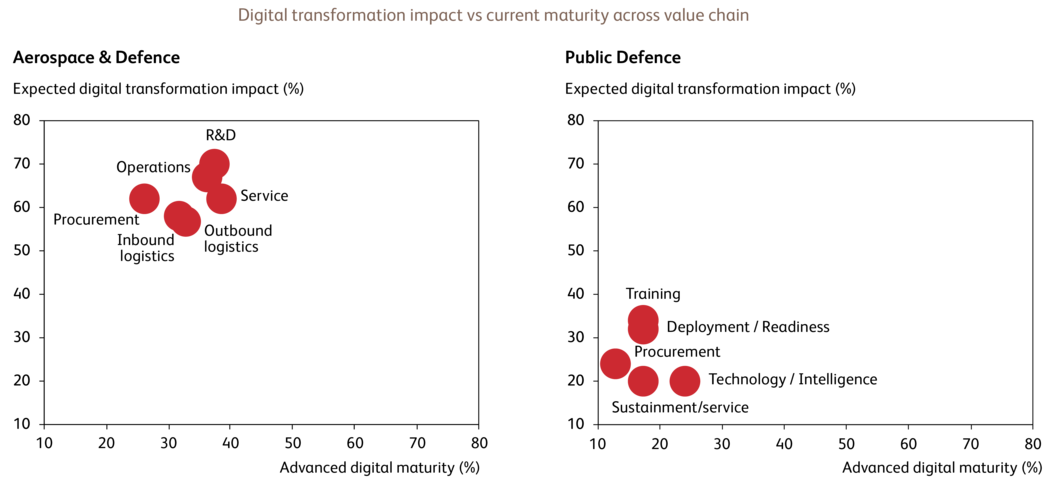
In the Aerospace & Defence industry, executives expect digital transformation to deliver high impact across core functions, most notably R&D (70%) and operations (67%), followed by service and procurement (62% each). However, advanced digital maturity remains significantly lower across these functions, highlighting a persistent execution gap. The gap is most pronounced in procurement and R&D, indicating that the functions most critical to industrial throughput and innovation are also the least digitally industrialised.
In the Public Defence sector, digital ambition is strongest in training (34%) and deployment readiness (32%), reflecting a clear focus on operational effectiveness. At the same time, procurement (24%) and sustainment (20%) receive less emphasis, and digital maturity remains uneven. While technology and intelligence show comparatively stronger maturity, procurement and lifecyclerelated functions continue to constrain scale and speed.
Together, these findings point to a structural challenge. Ambition is high, but execution capacity has not yet caught up.
Europe’s defence challenge is no longer just about funding. It is about execution. While digital ambition is high, many organisations still lack the execution capacity, interoperable architectures, and data foundations required to deliver capabilities at speed and scale.
Manuel Schuler, Global Leader Automotive, Manufacturing and Defense at BearingPoint

What is holding digital transformation back
Across the defence ecosystem, the barriers to scaling digital transformation are less about technology availability and more about people, governance, and structural constraints.
In the Aerospace and Defence industry, scaling is primarily constrained by execution capacity. Skills shortages, budget pressure, workforce fatigue, and limited supplier collaboration slow the transition from pilot initiatives to industrialscale digital delivery.
In Public Defence, structural constraints dominate. Budget rigidity, fragmented data silos, organisational resistance to change, and complex governance models continue to hinder the implementation of interoperable digital architectures. These factors limit the ability to scale digital capabilities across institutions and across borders.
Investment priorities are shifting but gaps remain
Study findings also highlights a clear shift in digital investment priorities across the defence ecosystem.
In the Aerospace and Defence industry, past investments were led by cybersecurity, with predictive analytics and digital twins close behind. Looking ahead, priorities are shifting decisively toward AIenabled decision support, digital twins, and supply chain visibility. This signals a move away from defensive investments toward operationally integrated, datadriven capabilities.
In Public Defence, investment priorities are also moving toward predictive analytics and digital twins to strengthen planning, training, and simulation. However, foundational enablers such as crossfunctional data platforms and workforce enablement remain underprioritised. This creates risks for secure, scalable, and sustainable digital transformation.
What needs to happen next
The findings make clear that digital transformation in defence is now an ecosystem challenge. Closing the digital execution gap requires coordinated action across industry and public defence, focused on five strategic priorities:
-
1.
Industrialise digital transformation across the defence value chain
-
2.
Establish interoperable digital architectures across the defence ecosystem
-
3.
Rebalance investment toward sovereign data foundations
-
4.
Strengthen institutional and industrial execution capacity
-
5.
Embed resilience and cyber sovereignty by design
Together, these actions shift the focus from isolated digital initiatives toward scalable, missionassured execution across the entire defence ecosystem.
Digital transformation in public defence is less about technology adoption and more about institutional alignment.To strengthen operational readiness, defence organisations must modernise governance, break down data silos, and build the capabilities needed to scale digital solutions across institutions and borders.
Reinhard Geigenfeind, Global Leader Public and Health Services at BearingPoint

Download the full study to explore the findings and recommendations in detail.
1 BearingPoint research based on a survey of 151 senior executives from the aerospace & defence industry and public defence organisations across Germany, France, the UK, Italy, Sweden, and Finland, conducted in December 2025.